Showing posts with label Korea. Show all posts

Tuesday, May 10, 2011

Buddha's Birthday

Bongeunsa Temple in Gangnam, Seoul
May 10th of every year is special for being the birthday of somebody near and dear to me. May 10th 2011, however, is special to many people around the globe for being the birthday of Prince Siddhartha Gautama a.k.a. Buddha.

East Asian countries following the Chinese Lunar calendar (all but Japan) celebrate Buddha's birthday on the 8th day of the 4th month. For some, it is an event worthy of an entire month of celebrations, while for others, it is merely a day off work and an excuse to visit the local temple to take in the colorful displays of lotus lanterns.

My only direct experience with Buddha's birthday comes from South Korea. Even though only about 20% of the population identifies as Buddhist (close to 30% are Christian, while most of the remaining population do not identify as any particular religion), Buddha's birthday is a public holiday and is marked by celebrations at all of the major temples. Though I cannot speak for the other major cities in Korea, Seoul holds a big festival, typically the weekend before the official holiday, which culminates in a huge parade through the city. During the preceding month, colorful lotus lanterns are hung around temples and at strategic points throughout the city. The temples, gorgeous and peaceful during the daytime, become magical during the fresh spring nights when the lanterns are lit. It is truly one of the best times to experience Seoul, a brief sojourn into the world of perfect spring weather squeezed between the harsh winter and the oppressively hot, humid, and rainy summer. During last year's festivities, even though I had to get up and work at 6 am the following morning, I made myself get out to soak in the parade and the flawless night. Though I typically am not a fan of the crowds in Seoul, it was totally worth it. I'd love to experience this holiday again in another part of the world. But until then... happy birthday, Buddha!

The weekend before Buddha's birthday, there is a parade through Seoul starting near City Hall and ending at Jogyesa temple. Many people wear traditional clothing, like hanbok, to march in the parade.
festivities at Jogyesa temple
Buddha flies into Seoul in a glowing helicopter these days. 21st century Buddha.

Sunday, April 17, 2011

photo of the day: Lindsu in Yeosu (S. Korea)


In another "one year ago today" post... I spent the evening of April 17, 2010 watching the sunset over the Yeoja Bay mud flats in Yeosu, Jollanam-do, South Korea.  Earlier that morning, I had gotten up at the ass crack of dawn after riding a bus all night from Seoul to hike a mountain for the sunrise.  Yes, I intended on watching that shit come full circle, baby.

During one year in Asia, I probably [intentionally]* experienced more sunrises than all previous years combined-- certainly something to think about as I am home and valuing sleep above all else, even though I am in no way under the same stresses I faced working in Seoul where I still managed to spend the weekends traveling and waking up to watch the sun rise.  Hmm...


*I say "intentionally," as I am not counting the innumerable sunrises I witnessed on the way to morning swim practices, as they were not quite appreciated for all they were.

Thursday, April 14, 2011

happiness is...

...cherry blossoms in the springtime.

Seriously, everyone always goes nuts for the cherry blossoms, with festivals popping up all over the world to celebrate their arrival... which always makes me inclined to say "ehhh, what's the big deal?"  But I'll admit that it brings me out of my winter funk a bit to suddenly see bursts of color emerging where barren trees had previously stood.

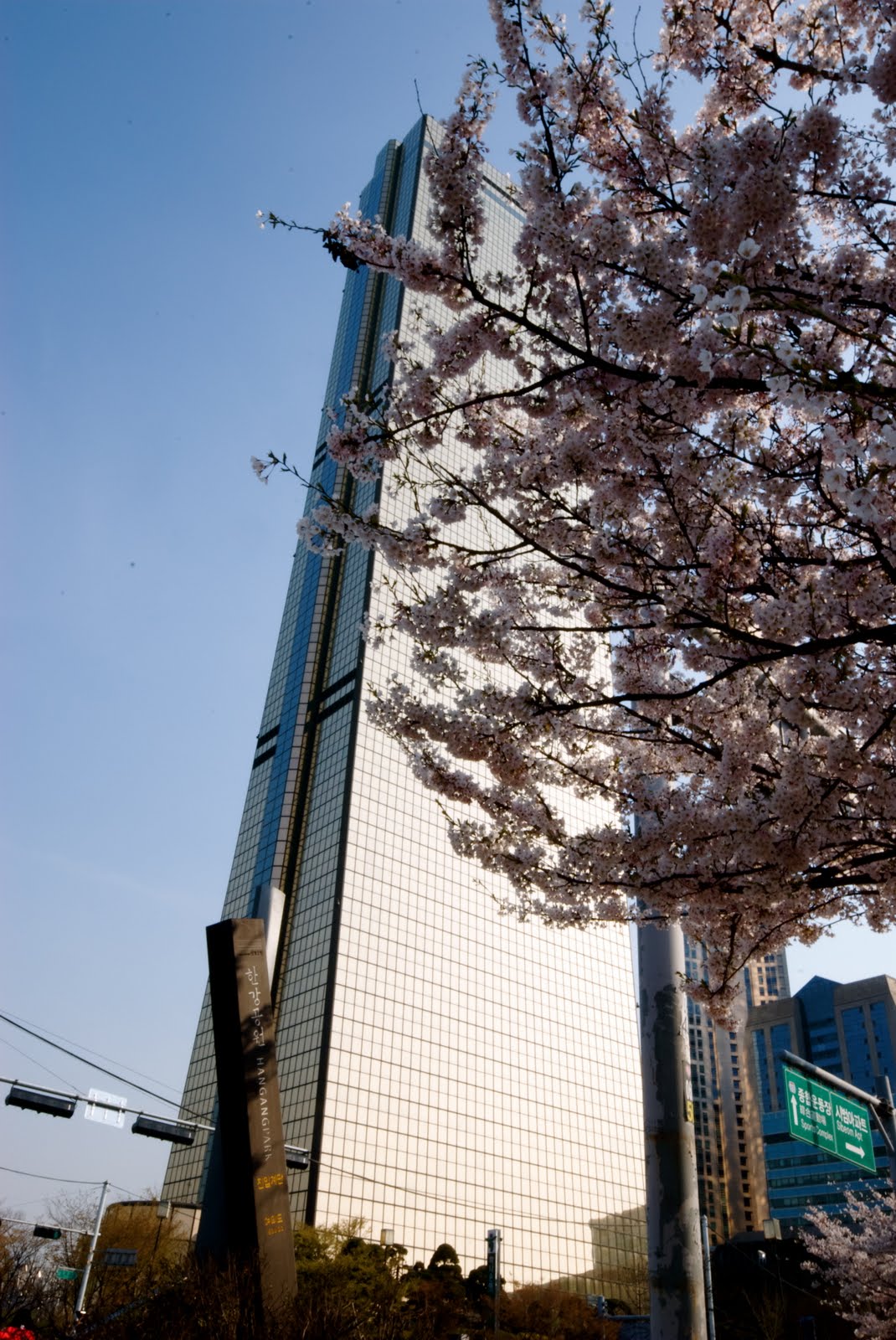
Cherry trees in bloom in front of the 63 Building in Yeouido- the tallest building in Korea

The island of Yeouido in Seoul is the best spot in the city to witness cherry blossom season and is always great for a walk or bike ride along the Hangang.  Right about this time last year, I was delighted to be brought back to the world of the living with the arrival of spring in Seoul.
(Yeouido is along Line 5/Purple- stop Yeouido lets you off near the National Assembly and close to the start of the festival, while Yeouinaru is closest to Hangang Park and the path along the river)

Wednesday, April 13, 2011

requisite biweekly shark post with a side of dog meat and ethical dilemmas

Kind of joking.  I never intended to post this frequently (now 3 times in 6 weeks?) about the cartilaged creatures, but here I am again (sort of... this post actually evolved to have almost nothing to do with sharks).

Galding posted an article yesterday using California's proposed ban on shark finning (a practice I previously mentioned here) as a launching point for a discussion of the global politics of culinary delicacies, which made me think a bit about my own experiences with food and culture abroad and at home.  The author raises the question of how to strike a balance between wildlife conservation/ethical food production and the preservation of culture.  While shark finning is a gruesome practice that for me is hard to justify with the argument that shark fin soup is integral to Chinese culture, there are other dishes that might not seem "ethical" to many "Westerners" that I have no problem with.  The author writes, "The Philippines has long been under fire for its mistreatment of dogs destined for the dinner table. I don't condone animal cruelty in any form (which is why I want to see gavage [sic]), yet we must also realize that pets are not a traditional part of that culture."  Just to clarify, the Philippines outlawed the eating of dog meat in 1998.  Though there is an underground market for it, most younger Filipinos did not grow up eating dog meat and think of dogs only as pets.  I'm really curious though as to what extent the doggie legislation came about through Western influences-- something that reminds me of a very similar issue in South Korea.

In Seoul, the capital city of South Korea, the sale of dog meat has been illegal since 1984, though the law is barely enforced and one doesn't have to look too hard to find dog meat in the city's traditional markets or in restaurants specializing in 개고기 (Gaegogi aka dog meat).  Hell, it took me less than a week of living in Korea to see my first frozen Fido.  Lindsey, my co-worker leaned in to warn me, you know some people here eat dog, right?  Moments later we passed a large dog in its entirety on ice-- and nowhere special, this was just the market closest to my home and workplace.  Many older Koreans continue to consume dog meat from time to time (especially men-- for stamina, of course!), but far fewer of the younger sect eat it with any regularity and many refuse to eat it at all on the same grounds as most Americans-- dogs are pets, not food.  But where did this shift in perception come from?  I'm willing to bet that most of the men that passed the law back in the mid-80's are part of the crowd that still visits their favorite gaegogi joint from time to time for "stamina soup."  If you remember correctly, Seoul played host to the Summer Olympic Games in 1988.  In talking to older Koreans (one of the distinct advantages of teaching English to adults), I learned a bit more about the historical state of dog meat affairs.  Apparently, in the years leading up to the Olympics, the government tried to phase out the selling of dog meat-- or at least run it underground-- in an attempt to appease the international (read: Western) community and shed the label of "backwards society that eats dogs."  At this point in time, South Korea was beginning to show significant signs of recovery from decades of poverty following the Korean War and was naturally eager to showcase its progress to the world during the upcoming Olympic Games.  They didn't need to be torn apart in the Western media for their culinary practices when their opportunity to become a bigger global player was on the line.  And so the visibility of dog meat quickly faded, and the practice has since steadily declined.

 Side note: I am Olympic Fanatic.

Is it fair?  What surprised me most upon seeing a full dog on ice in the market was its size and build  This clearly was not someone's pet; it was an animal bred specifically for one purpose: human consumption.  In Korean, these dogs are known as
누렁이 (Nureongi) and 황구 (Hwangu), clearly distinguishing them from the type of "dogs" that are considered pets.  For many, that still doesn't make it right, but I don't think you can point the finger at Asian communities for centuries of domesticating dogs as livestock while innocently consuming beef or chicken that comes from American slaughterhouses.  Cows are sacred to the Hindu community, and it is illegal to kill a cow in Nepal and most Indian states, yet Americans consume an average of 67 lbs of beef per year.  If the 1.4 billion people of India and Nepal got together and decided to vilify Americans for their consumption of cows, what would the response be?  Many people would probably laugh at the audacity of the two South Asian countries for suggesting such a thing.  So why does the West get to decide what is globally acceptable at the dinner table? (and I ask that with regard to food production only and issues of conservation aside-- as I do think it is important that global measures are being taken to protect threatened and endangered species)

So what is my personal philosophy on food, culture, and ethics?

I absolutely draw the line at threatened or endangered species, especially when many of them are killed not for survival, but for sale as delicacies, often wasting most of the edible parts of the animal and leaving them to die a cruel death, the way sharks are definned and then thrown back in the ocean to perish.  As a somewhat recent fish consumer, I'm working to become more knowledgeable about sustainable fishing, as I would like to get the occasional super dose of omega-3's without contributing to the destruction of our fragile ocean ecosystems. 

After that, the lines are hazy.  I have been trying to become a more conscious consumer.  For both health and ethical reasons, I eat significantly less meat than I did in the past, and when possible make more responsible decisions when it comes to the source of my food.  My personal decision not to become vegetarian or vegan has a lot to do with culture as well as the belief that one doesn't have to go to extremes to be more responsible or make a statement.  

First off, culture.  Anyone who tries to convince me that food is not an integral part of culture will ultimately fail.  We experience the world through our perception of sensory details, and what, other than the experience of eating and drinking truly uses all of our senses?  If you think back upon your childhood, how many memories feature food to some degree?  If you've traveled, can you honestly say that the experience yielded no culinary memories?  Travel has become a huge part of who I am and I would be remiss to claim that food is of no importance to my appreciation of different cultures.  Whether this means enjoying a buttery fresh baked croissant early in the morning while ambling through the streets of Paris or eating raw octopus on the Yeongmeori coastline of Jeju-do straight from the haenyeo (traditional female free-diver) who caught it, I don't want to limit my experience through a narrow definition of what constitutes acceptable food.  But there is also another, more direct cultural experience that concerns me.  At many times over the past year, I have been a guest at the dinner table, experiences that I am overwhelmingly grateful for and that rank as some of my fondest memories of time spent abroad.  Aside from wanting to be polite and try everything offered, there have been times when the meal I have been served as a guest is considerably more expensive than what the host would normally cook-- how can I possibly eschew the relatively expensive chicken that I am being served on ethical grounds knowing that my gracious host will go back to a diet of rice and lentils for weeks to compensate?  I just can't.  When my host has her husband go miles out of the way to pick up special curd from another town for dessert, how do I refuse it and explain that I do not eat any products that have in any way derived from animals?  I don't.  I can't.  Not only does it not translate to the majority of humans around the globe, but getting on my ethical high horse in that sort of situation just doesn't seem right.  


 eating octopus by the sea, straight from the woman who caught it, right next to where it was caught- doesn't get much more local than that, right?

I know it is not every day that I'm in a situation that demands those decisions of me, but I am not really keen on undertaking a lifestyle of extremes such as veganism knowing full well that time and again I will make exceptions in the pursuit of understanding and respecting other cultures.  Nor do I think that eating healthy and ethically has to come in the form of extremes, as it only serves to further alienate the majority of the population who cannot afford such a lifestyle.  Millions of Americans struggle to get enough fruits and vegetables in their diets-- not because they are ignorant or lazy, but often because the things that are heavily subsidized by the government (corn, meat, processed dairy) are more affordable and more filling, despite how nutritionally poor and lowbrow on the foodie scale they may be.  Healthy and responsible eating should not have to be expensive, divisive, or elitist.  But if the poor keep eating poorly
based on the few affordable choices they have (and looking at the factors for beef consumption in America, geography, income, and race have a significant impact on who relies most on meat in their diets) and the rich who can afford to make food choices that reflect how "socially conscious" they are continue to buy into their exclusive diet and lifestyle clubs, what will change?  What incentive (other than it being the responsible thing to do) does the government have to correct the subsidies that encourage these unhealthy behaviors?  What incentive do companies have to target health foods at a wider population and offer them at more affordable prices when they already have a faithful elite that keep them in business by paying top dollar for organic-local-vegan-status-symbol products?  There really isn't much.  In this way, I think the small changes have the potential to be most effective.  If enough people start to be a little more discriminating about what they put into their bodies, I believe it can have a much stronger impact than if a teeny tiny fraction of the the population decides to cut out entire groups all together.

I've rambled a bit, from shark finning and dog meat to culture and American diets.  Things got out of hand.  Food is fascinating, isn't it?


I'd like to just end with something that I read awhile ago on my friend Andy's blog, which really seems to sum up the conundrum I face balancing health and social responsibility with respect and appreciation of culture when it comes to food:
Eating nutritious and local food is important to me, but I don’t want to turn my back on culture to do it.  Truly experiencing food is what I’m after, and if that calls for settling for imperfection here and there, bring it on. In a perfect world, we’d all grow turnips in our backyards and eat them like candy.  In a perfect world, our farmers would tell us what to eat, not our televisions.  In a perfect world we’d all be eating well.
Truthfully, I’m happy with eating goodly.*
*Eating Goodly is the name of Andy's blog- as a future Master of Management in Hospitality student at Cornell, I assure you he can get away with making up words to make a point.  For some thought provoking posts on food (from ethics and culture to darn good french toast and beer), I encourage you to check it out!

Sunday, April 10, 2011

for the love of snail mail

I am a dying breed.  I am a generous sender and gracious recipient of items carrying a stamp.  Put simply, I have quite the affinity for snail mail.  Though I appreciate the swiftness and ease of the email, part of me laments the waning of the hand-written letter as a means of communication.  Not that every correspondence need be rife with sentimentality, but there is something about snail mail that feels a bit more thoughtful than mail of the electronic nature.  That's not to say that every letter is inherently meaningful or affectionate, or that an email cannot be thoughtful and intimate (my own father's short, reflective emails while I've been away have been known to provoke emotional tears), but in this electronic age there is something special about receiving correspondence by way of the "old fashioned" post.

On the sender's side, I've found that it is nice to take a brief moment to write someone, with pen and ink, especially during times of prolonged absence.  With stationary and postcards abundant and cheap in Korea, I often carried writing supplies in my bag to jot down a funny story, recall a moment that made me think of a friend, repeat some ludicrous Konglish a student had uttered, or just to jot some something far from profound- a doodle, a friend's name in Korean, a random question on my mind- in one of my many Sakura Gelly Roll pens.  And just when I had completely forgotten about the mail on its 8,000 mile journey and was trudging through an exhausting day of work, there might be a little note in my inbox that a letter had arrived in the mail and was much appreciated.  Or maybe a year later, I would meet a friend's roommate only to be instantly recognized as "the postcard girl."  Or that.

Conversely, I am also a huge fan of receiving mail.  Maybe it is corny, but my weekend was brightened a little when Saturday's mail brought not one but two parcels- a thoughtful note that made me smile and laugh out loud and a book recommended and lent to me based on my interest in women and gender in the Middle East.  During my stay in Korea, coming home to mail never got old, and I was eager to liven up my dreary bedroom and classroom walls with bright cards of cartoon dinosaurs and octopi (my friends rock), tear-outs from The New York Times Magazine that arrived in a Christmas package, and postcard scenes of the USA.  I know that some people probably are not that fazed by snail mail, likely including some who frequently received my mailed musings from abroad, but if there's even a chance that I can make someone feel, even for just a moment, like somewhere out there someone is thinking of them, then mission accomplished.  Or maybe I'm just exerting my existence.  Read into it however you like.

Last week I received the following gem from Miss M, formerly of Australia, currently of Thailand (that brat), and while I wouldn't normally share my "private" dealings with M (you know, because postcards that can be read by anyone handling the mail are super duper private and the following clearly is meant for my eyes only), I just want the world to know that I am the "Dinotine" to her "Loveasaurus."


Also Amz Kelso, creator of this dinotastic image, you are awesome.  Just sayin'.

Tuesday, March 22, 2011

hey laaaadiees (a different type of, ahem, tourism)

A few months ago, I was on a bit of an evolutionary biology reading kick (highly, highly, highly recommend reading Sex at Dawn, hands down one of the most entertaining, informative, and thought-provoking books I've read in the past year-- make that several years, actually).  Between a well-delivered fun fact about gorilla testicle size while cabbing it downtown on a New York Saturday night and a gem of a map that I stumbled upon just now and have to share, I've got evolutionary biology on the brain again.

The following world map gives a breakdown of the world according to penis size.  I am in no way commenting on the importance of said measurements and do not want to read too much into the underlying tones of this dick waving contest as a pretext for global politics, but hey, it's science!


Korea, my former country of residence, ranks the lowest, coming in at at average of 3.9 inches and confirming the wisdom learned from a Filipino whore last spring.  In the Philippines, among sex workers, Korean men are often referred to as "3x3x3s."  3 inches, 3 minutes, 3,000 pesos.

And if you are into, ya know, the more well-endowed, it might be another reason to go seek out a Latin lover (hmm... do I sense a forthcoming chapter on "how Lindsey got her groove back?").  But whatever you do, keep it safe, kids.

Tuesday, March 8, 2011

on the 100th anniversary of International Women's Day...

Forgive me for being cynical, but for all the "progress" for women's rights that is being lauded today, I see a lot of ways in which we are missing the mark, both globally and at home in the US.

When I was living abroad in Korea, I starting thinking eh, things for women in the US aren't thaaaat bad, right?  At home, I usually don't entertain questions of why I am not married at 24 (and I was 22/23 at the time I was fielding said questions).  I can apply for jobs knowing that it is my resume being scrutinized rather than a requisite attached photograph, and I am not being told to get plastic surgery to land a job in my field of choice.  I went to a good university for more than just my MRS degree (and, anyway, it would appear that I have failed to achieve a "joint-degree").  30 "Korean age" (28 or 29) is not a death sentence for my career and any hopes of starting a family or being an acceptable member of society.  I have been given access to information that helps me to make informed choices regarding my own sexual health, and finally, at 24, feel comfortable navigating a tricky playing field in which men often exercise far more control than women-- my decisions really are my decisions.

But for all of that, there are the buts.  Since returning to the States, I have been bombarded by the vitriolic rhetoric our politicians are spitting.  It seems that many lawmakers in this country have made it their goal to vehemently oppose women's rights through agendas that are decidedly anti-reproductive health.  Regardless of your stance on abortion, it is legal in this country.  Research indicates that abortion rates are no lower in countries where the procedure is illegal-- the difference is that women seek unsafe methods to terminate pregnancy.  Globally, about 13% of maternal deaths are caused by unsafe abortions.  And this seems pretty obvious, but unwanted pregnancies occur when family planning services are either not available, not being utilized, or not being advocated.  Family planning is simply "the conscious effort of couples of individuals to plan for and attain their desired number of children and to regulate the spacing and timing of their births."  This doesn't necessarily mean the use of modern contraception; it could simply mean a conversation between two individuals to decide whether fertility is a goal or not.  The reality is that in much of the world these conversations do not occur.

Sexual education matters.  Attitudes about gender matter.  In Korea, I was baffled by how little young adults knew about sex.  Health knowledge in general seemed to be dominated by rumors and old wives tales.  Modern contraceptives are readily available in Korea, but sometimes I had to remind myself of that fact.  In fact, birth control pills are often available over the counter for very little money (about $5), but relatively few sexually active women use them due to misleading information from doctors and hearsay from friends, and the prevailing attitude that sex is a man's realm, and therefore women should not be involved in decisions about when to use birth control.  As a result, an alarming number of abortions are performed every year in secret clinics (as abortion is illegal).  In 2005, there were over 340,000 abortions in South Korea, while there were 476,000 live births, suggesting that roughly 2 in 5 Korean pregnancies result in termination (if those numbers are not gross underestimates due to the secretive nature of illegal procedures).  The situation in South Korea is simply one of many anecdotes regarding the interplay of misinformation, the effect of gender and culture, and restrictive reproductive health legislation.  Why then do certain groups in the United States want to deny access to family planning services (many of which are already unaffordable for a lot of people) and encourage school curricula that pay insufficient attention to sexual and reproductive health?

In class of mine a little while back, I saw the following statistic:

"Men between the ages of 15 and 44 face no single threat to their health and lives that is comparable to maternal death and disability."
-UK All Party Parliamentary Group on Population, Development and Reproductive Health

The reality is, that most Americans don't view pregnancy as a huge threat to our health.  If it is planned, childbirth is an occasion for celebration in "developed" countries, but globally about 1,000 women die per day from complications arising from pregnancy and childbirth.  99% of these deaths occur in "developing" countries, and almost all are preventable.  Difficult childbirth can also leave women with additional health concerns, such as anemia, infertility, abdominal pain, and fistula (which often results in the woman being shunned from the household).

If this were a "men's issue," would it be handled differently?

I tend to shy away from arguments that might seem to vilify men in this realm, because while there are a lot of upsetting gendered reasons why women's health is often neglected globally, men are an important piece of the puzzle and should be utilized rather than alienated in the women's movement.  I think that too often feminism gets equated with thinking that women are better than men or that men need to be knocked down a few pegs, when in reality most people who consider themselves feminists are simply looking to level the playing field and certainly are not looking to trample all over men.  I find that I sometimes shy away from identifying as such because it carries such different (and somewhat extreme) connotations for some people.  Do you give a shit about reproductive health and fair pay?  OK, cool.  Me, too.

While women's health is a crucial part of the equality puzzle, the theme of this year's International Women's Day is "work," so why not take a look at US women in the workplace?  (Granted, the theme is really the "pathway to decent work for women" rather than "equality in the workforce," but as this is something that I do think the US can be somewhat proud of, I want to look at what comes after the initial foray into the workforce: equality in the workforce).  Like I mentioned before, I feel fortunate to be a woman working in the US.  It probably is not great that my justification for this is simply a comparison with a typical 24 year-old woman in Afghanistan or even a comparison with one in S. Korea (one of the so-called most developed countries).  But at least I've been educated, legally can work in the same fields as my male counterparts, and have not been married off against my will or forced to get pregnant before I could make my mark in the workplace.  So, win?  Oh, wait, but I'll likely never make as much money as my male counterparts, even though there are, like, laws about that shit.  Hello, glass ceiling.  But how bad could it really be?

As I am going into a sector that works closely with the medical field, let's look at how women fare there. The New York Times ran an article accompanied by a really cool interactive graphic last year titled "Why Is Her Paycheck Smaller?"  I would encourage everyone to check it out-- if nothing else, it is just a super-fun interactive graph (woo!).  Female physicians and surgeons make about 40% less, while medical scientists make 37% less.  Although some of the gap can be explained by differences in specialties (for instance more men going into certain high-paying surgical specialties than, say, pediatrics or family and community medicine), that is not enough to explain a 40% gap.  40%.  Whoa.  Another study looked at starting salaries for physicians, so as not to run into problems trying to compare across specialities or later in life when men and women might opt for different types of benefits.  In 2008, female physicians' starting salaries were $17,000 less than starting salaries for male physicians.  In 1999, that difference was $3,600.  Is that what progress looks like?  And when we explain such staggering differences by saying that women are choosing different types of benefits (like more time off, less hours, etc. because they have families and certain roles they are expected to play within them), does it matter that this is often a reflection of a constrained choice?

A question that is often asked is whether the quest for women's rights is a zero-sum game.  Can women attain gender equality without men relinquishing some of the power and privilege they currently enjoy?  Is it reasonable to ask men to make such sacrifices?

What do you think?  Is gender equity/equality a zero-sum game?  Are we making sufficient progress?


my refusal to fold becomes costly

This morning I cracked open a book to find a 10,000 won note.  A whole lot of good that does me in America.  That's a night of Korean BBQ!  Two bowls of dolsot bibimbap!  A tea set from E-Mart!  Thirty red bean filled fish cakes!  Twenty hot-tteoks!  (and then 1/10 of the gym membership required to work them off my hips!)


I really need to stop using cash money as a stand-in for a bookmark.  At the very least, couldn't I have done this with a 1,000 mark?  

mmm hot-tteok in Insadong- this stand would cost 900 won each (instead of 500 near my former abode), so I could only buy eleven with my bookmark won, cutting my theoretical gym time from four hours a day down to two.  oh, the sacrifices one makes for hot-tteok...  
*also, props to anyone who can polish off more than one or two of these and not want to die.  there is definitely a significant hot-tteok threshold- once you hit it you go from this is the most amazing paty in my mouth to send me to north korea to die an untimely death at the hands of dear leader for I cannot handle the copious amounts of oil and brown sugar coursing through my veins

Monday, February 28, 2011

exposing myself to Korea

When I arrived in Korea on my one-year working visa, there were a few strings attached.  Aside from shipping away my diploma and a medley of notarized documents to Seoul prior to my arrival, there were a few things that needed to be taken care of upon touching down fourteen time zones into the future.

Lest they allow any impure mudblood foreigner taint their aseptic culture, immigration requires a thorough physical of all foreign visa holders (or "body check" in creepy Konglish).  Fail this, and they send you packing.  For visiting foreigners (who from most countries are granted a 90-day tourist visa), HIV disclosure is not mandatory.  If, however, positive HIV status is revealed, you'll be given the boot.  For all foreigners on working visas, blood work is done ASAP to confirm negative HIV status.  While this is a questionable human rights issue that makes me feel a bit uneasy, countries do have the right to make their own immigration laws, and S. Korea is not alone in requiring HIV testing for prolonged stays.  In fact, until 2010, positive HIV status could restrict entry to the United States (though immigration did not test for it, failing to disclose positive status could be considered "immigration fraud").  While it is still considered a "communicable disease of public health significance," HIV no longer bars individuals from entering and residing in the United States, which is a considerable step forward as we increase our understanding of the disease and aim to reduce the stigma surrounding it.

In addition to HIV tests, they require a few gallons of urine for, among other things, extensive drug testing.  In reality, it is more like a pint, but it sure feels like gallons when you are nervous, dehydrated, and trying to aim to fill a cup and several test tubes while straddling a squat toilet.  As I was particularly inept when it came to squat toilets (oh what a difference a year would make), this also required partial undressing as to avoid reeking of urine throughout the rest of the day with three hours of class left to teach.  My heart went out to the friend with the childhood fear of soiling his clothes that to this day requires him to completely undress to take a shit, a task made particularly difficult in business attire.  I would undress, squeeze out a few drops, get dressed, wash the cup of urine that I was about to stow in my pocket, and hit the vending machine for yet another cup of coffee.  The staff member that brought me to the hospital would call to wonder if I had left without her, and I would inform her that I regrettably had yet to produce an ample enough urine supply.  My so-called "diuretic" would fail me once more, and I'd be left to contemplate my performance anxiety and start the process all over again.

And I haven't even gotten to the good part.

Immigration also wants to make sure that you don't have TB.  Instead of doing a tuberculin test, they run a chest X-ray.  I was led down to radiology by an English speaking aspiring med student volunteer who instructed me to take off all my clothes, including underwear, and slip into hospital attire.  No problem... except that they only are providing shirts.  Now I know there are a lot of 4'10" adjummas running around, but this thing really seems to short to be intended for use as a gown.  So I asked for pants.  "No pants."  Wait, whattt?  This girl definitely understands English.  But I ask again.  "No pants."  I peek outside the curtain I am changing behind.  In addition to the technicians and my volunteer, there is a room full of old Korean male patients.  All wearing pants.  Now I've only been in this country for a week, and I am pretty sure that modesty, particularly between men and women, is a pretty big deal.  But maybe there is a different standard that applies in a medical setting, kind of like how people casually talk about having diarrhea as if it were a headache.  So I brace myself to bravely Pooh Bear a room full of strangers.  I'll never see them again, right?  For those of you who don't know what I mean when I use "Pooh Bear" as a verb, let me remind you of what Pooh Bear looks like.  More importantly, what he wears:

hello, world!  isn't life better without the constraint of pants?

I mumbled a lot of incoherent words about seeing a lot of my ass and nervously penguin waddled out from behind the curtain.  Volunteer stares at me awkwardly and tells me I can keep my pants on.  But you just told me several times not to wear pants, you sadistic fuck.  Oh, I technically was never wearing "pants" because I was wearing a skirt.  Kill me now, I just Pooh Beared a room full of strangers.


Thursday, February 24, 2011

hello world, here's my cliché "beginnings" post

I'll preface this entire project (lifestyle?) by quoting the lovely Margaret Atwood, just as I did my last blogging endeavor...

In The Blind Assassin Margaret Atwood writes:

“Why is it that we want so badly to memorialize ourselves? Even while we’re still alive. We wish to assert our existence, like dogs peeing on fire hydrants. We put on display our framed photographs, our parchment diplomas, our silver-plated cups; we monogram our linen, we carve our names on trees, we scrawl them on washroom walls. It’s all the same impulse. What do we hope from it? Applause, envy, respect? Or simply attention, of any kind we can get?

At the very least we want a witness. We can’t stand the idea of our own voices falling silent finally, like the radio running down.”


I offer this passage as the anthem to the Millennials.  Say what you want about us, maybe we are all just attention seeking whores.  But is it so bad to want a witness?  Perhaps memorializing ourselves is not something undertaken in an act of attention seeking, but rather in pursuit of a future pause for reflection.

A year and a half ago, when I left the Northeastern US for Seoul, S. Korea, I deliberated for a long time over whether or not to keep a blog.  In the end, I resolved to put away my blogger judgment and give it my best effort.  Sure, I had a small audience who tuned in now and again to see me make an ass of myself in my new surroundings, but ultimately I wrote for myself.  Looking back, it is easy for me to form opinions one way or another about my overall experience in Korea.  But reading through that stupid blog chronicling the ups and downs over the span of my year in Korea reminds me that life is not just about the averages.

So, here I am again.  Insert something cliché about "starting over" here.

Related Posts Plugin for WordPress, Blogger...